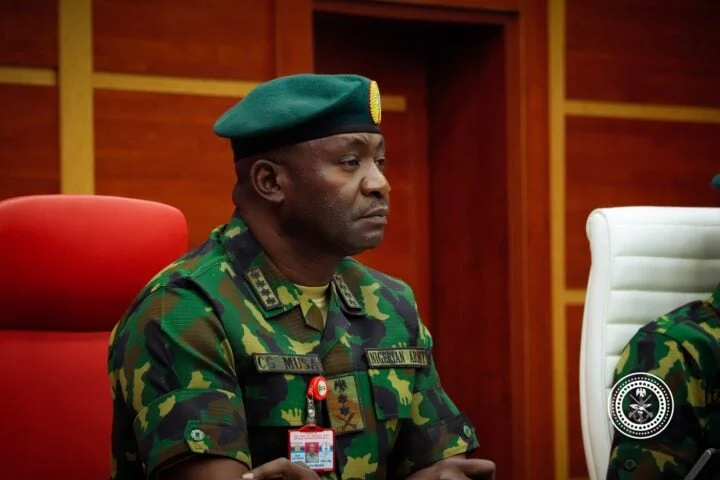
Nigeria’s worsening security situation has once again come under national scrutiny as the country’s Defence Minister, General Christopher Musa (Rtd.), summoned top military commanders for an emergency meeting in Abuja.
The high-level meeting, held at the Ministry of Defence headquarters, brought together key figures in Nigeria’s security architecture, including the Chief of Defence Staff, the Chief of Army Staff, the Chief of Air Staff, and the Chief of Naval Staff. Representatives from intelligence agencies were also in attendance as authorities sought urgent solutions to the growing wave of insurgent attacks across parts of the country.
Rising Attacks in the North-East
The emergency meeting was convened following a series of deadly assaults on military formations in Nigeria’s North-East, particularly in Borno State and surrounding areas. Reports indicate that terrorists launched coordinated attacks on several military bases, resulting in the deaths of senior officers and multiple soldiers.
In some cases, militants were able to seize weapons, vehicles, and other military equipment during the raids, highlighting growing concerns about the operational capacity of insurgent groups and the vulnerability of certain military installations.
Beyond the military casualties, the attacks have also affected civilians. Many residents in the affected communities have reportedly been abducted or displaced, further worsening the humanitarian crisis in the region.
Government’s Response
Speaking briefly before the meeting moved into a closed-door session, the Defence Minister acknowledged the losses suffered by the armed forces but insisted that terrorists have also sustained heavy casualties in recent confrontations.
According to him, the purpose of the meeting is to review existing military strategies and adopt stronger measures that will help the armed forces respond more effectively to the evolving threat posed by insurgent groups.
The minister reaffirmed the federal government’s commitment to protecting lives, securing communities, and restoring peace to the troubled North-East region.
A Persistent National Challenge
Nigeria has battled insurgency and violent extremism for more than a decade, particularly in the North-East where terrorist groups continue to launch attacks on communities, security forces, and infrastructure.
Security experts say the situation has become increasingly complex, with insurgents using more coordinated tactics, including surprise raids on military bases to capture weapons and supplies. These developments have raised questions about the country’s long-term counterterrorism strategy and the capacity of security forces to maintain control in remote areas.
The recent meeting between the Defence Minister and the service chiefs signals that the government is taking the renewed surge in attacks seriously. However, many Nigerians are watching closely to see whether the discussions will translate into concrete actions on the ground.
What Comes Next?
For now, the outcome of the emergency meeting remains undisclosed, but new directives and possible strategic adjustments are expected to be announced after the military leadership completes its review.
As Nigeria continues to confront insurgency, banditry, and other security threats across multiple regions, the effectiveness of the country’s military leadership will play a crucial role in determining whether lasting stability can be achieved.
Until then, the security crisis remains one of the most pressing challenges facing Africa’s most populous nation.
