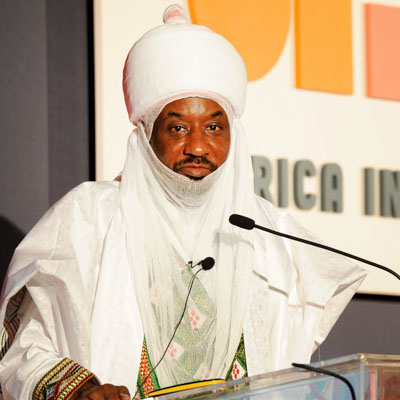
The Emir of Kano, Muhammadu Sanusi II, has raised fresh concerns about the Federal Government’s rising debt, questioning why borrowing persists despite the removal of petrol subsidies.
Speaking in an interview published by News Central TV on Friday, the former Governor of the Central Bank of Nigeria acknowledged that reforms such as subsidy removal and exchange rate liberalisation were necessary. However, he warned that poor sequencing and weak fiscal discipline could undermine their intended benefits.
Sanusi also criticised Nigeria’s long-standing reliance on foreign refining, describing it as a structural weakness, especially as local refining capacity remains underutilised.
“It’s not enough to say subsidy has been removed—you had to do it,” he said. “When a country reaches a point where nearly all its revenue goes into debt servicing, it becomes unsustainable. The question is: where will the money come from?”
He further noted that implementing subsidy removal and exchange rate liberalisation without first tightening monetary conditions contributed to the sharp decline of the naira.
“If you remove subsidy and liberalise exchange rates in a loose monetary environment, before controlling money supply, the naira will continue to weaken. That was a timing issue,” he explained.
Sanusi stressed that savings from subsidy removal should lead to fiscal consolidation rather than increased borrowing. He questioned the government’s current approach, insisting that the expected benefits of the reforms are yet to be seen.
His comments come amid reports that the Federal Government has increased its 2026 borrowing plan by ₦11.31 trillion, bringing total projected borrowing to ₦29.20 trillion.
Meanwhile, President Bola Tinubu has sought Senate approval for a fresh $516 million loan to finance the Sokoto–Badagry Superhighway project.
“We’ve removed the subsidy, and now we’re spending the proceeds,” Sanusi said. “But what we should be seeing is fiscal consolidation. You cannot eliminate waste and still continue borrowing.”
“If subsidy payments have stopped and funds are available, why are we still borrowing? What exactly are we borrowing for?” he asked.
